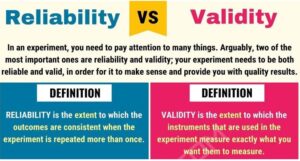
In grounding qualitative research,validity receives more importance than reliability. Validity means that the research is sound and based on solid grounds. Internal validity implies that the data used for research are not affected by any external impacts and are consistent throughout the research. While external validity means that the result of a study can be applied to a wide number of situations, and Reliability is a very important factor in assessment, and is presented as an aspect contributing to validity and not opposed to validity. Messick () transformed the traditional definition of validity - with reliability in opposition - to reliability becoming unified with validity. Thereby Messick () has Reliability and Validity. Issues of research reliability and validity need to be addressed in methodology chapter in a concise manner. Reliability refers to the extent to which the same answers can be obtained using the same instruments more than one time. In simple terms, if your research is associated with high levels of reliability, then other researchers need to be able to generate the same
% Essay: Reliability and validity dissertation plagiarism-free service!
Reliability and Validity in Research — This is a statistical concept in the field of research whereby a particular phenomenon is being evaluated or rated by various raters. It is, therefore, the extent or degree to which there is an agreement in the rating scores amongst the multiple raters, which brings about homogeneity and unanimity amongst these raters.
To measure inter-rater reliability, it entails taking the total number of ratings in a particular judgment conducted, as well as the counting the accumulative ratings are done in the rating exercise.
The total number of agreements is then divided by the total number of ratings and converted into a percentage to give the inter-rater reliability. McHugh provides a good example of how dissertation reliability and validity reliability is calculated by reviewing the various methods that have been stipulated by scholars previously.
This is also another reliability aspect. Test-retest reliability is the extent or degree to which results obtained from a particular test which is similar and consistent over time. In test-retest reliability, a similar test is administered to the same people in two or more instances and then the results are evaluated. To measure the test-retest reliability, there are two primary formulas applied. The first formula, dissertation reliability and validity, which is better applied in instances where two tests were conducted in the Pearson Correlation formula that tests how well two sets of data correlate.
The other method is intraclass correlation formula that is applicable where more than two tests were administered. These formulas help calculate the test-retest coefficients that range between 0 and 1. In his article on validity and reliability in social science research, Drost provides the various reliability and validity aspects and gives detailed examples of the test-retest reliability measurement.
Face validity, which is also referred to as the logical validity, dissertation reliability and validity, entails the extent or degree to which an evaluation or investigation intuitively seems to quantify or measure the variable or rather the theory that it is objectively meant to measure. This, therefore, means that face validity is when a specific evaluation or assessment tool does what it is meant to do to provide results.
To measure face validity, one can engage in the assessment of the concepts or ideas to be measured against the theoretical and practical applications. This is the measure of how accurate or effective a given value from a research study is and can be used in the future or rather to predict future patterns in the field studied.
This entails the degree to which current test results relate to results from a previous test. A good example of research that has employed the use of concurrent validity is the research done by Tamanini et al. The researchers indicate how this test is applied and measured by using it as their primary test in their research. On most qualitative researchers, the nature of the data is more important to the researcher than the other descriptive elements of the research.
This, however, does not rule out the need for conciseness in the descriptive sections. On the other hand, validity entails the accuracy and integrity of the data or results collected from the various tests that a researcher performs. Various researchers address these issues of validity dissertation reliability and validity reliability in different ways, based on the purpose and the kind of research they carry out.
The focus here, therefore, is more on the data validation to ensure that their conclusions, as well as the outcomes of the results, have the required accuracy and integrity to validate their arguments. The two authors and researchers have applied the aspects of predictive and concurrent validity in their research. In regards to the use of predictive validity, this is where their research question dissertation reliability and validity based on.
They have made sure that the data or the arguments that they bring forth as substantially valid and convincing to attain the objective of predicting the future academic performances of the children who undertake the public examinations that are governed by the various bodies in the country.
They have however not applied any reliability aspects in their research. At least not anyone that can be easily identified. In the book by Drost, he has touched on both aspects; validity and reliability.
In this book, he has not presented it in a dissertation reliability and validity form but rather brought it out to the readers in the form of a review of both aspects of research, but on the dimension of social sciences.
For instance, dissertation reliability and validity, she has covered the various instances of both validity and reliability, by providing real-life examples and the various methods that can be used to measure the respective instances of both aspects.
She approaches the concepts of validity and reliability from a general perspective whereby she accounts for the reasons as to why researchers, especially in education and social sciences, should adopt a culture of ensuring validity and reliability in their results, dissertation reliability and validity.
He explains the various instances of reliability and provides formulas and tools that can be effectively applied to measure these instances. She also provides the various elements that can impact the level of validity and reliability of data or results in research.
In conclusion, the concepts of validity and reliability are important in research. The researcher from various fields should adopt a culture of achieving these concepts in the results they obtain during their research. As Drost argues it, dissertation reliability and validity, strong support for the validity and the reliability of research not only makes the research highly validated or otherwise believed in but also limits the possible critiques that the research may dissertation reliability and validity. It fills the gaps that may be identifiable in the research.
A researcher should be able to understand the various instances of both reliability and validity as well as know when it is appropriate to apply what instance in the research, dissertation reliability and validity. McHugh, M. Interrater reliability: the kappa statistic. Biochemia Medica, 22 3 Drost, E. Validity and reliability of social science research. Education Research and perspectives, 38 1 Obioma, G. The predictive validity of public examinations: A case study of Nigeria.
Tamanini, J. International Braz j Urol, 30 6 LoBiondo-Wood, G. Reliability and validity. Nursing research. Methods and critical appraisal for evidence-based practice, University Dissertation Topics Approaches for Research Dissertations. If you enjoyed reading this post on reliability and validity, I would be very grateful if you could help spread this knowledge by emailing this post to a friend, or sharing it on Twitter or Facebook.
Thank you, dissertation reliability and validity. View all posts by Steve Jones. Your email address will not be published. Skip to content. Sharing Is Caring - Please Share This Post. Published by. Leave a Reply Cancel reply Connect with:. Next Next post: Community Economic Development.
3.11 Validity and Reliability Of Research
, time: 9:20Reliability and Validity in Research | Research Prospect

Reliability is a very important factor in assessment, and is presented as an aspect contributing to validity and not opposed to validity. Messick () transformed the traditional definition of validity - with reliability in opposition - to reliability becoming unified with validity. Thereby Messick () has through measurement of the validity and reliability.1 Validity Validity is defined as the extent to which a concept is accurately measured in a quantitative study. For example, a survey designed to explore depression but which actually measures anxiety would not be consid-ered valid. The second measure of quality in a quantita-tive study is reliability, or the accuracy of an blogger.com by: Jul 03, · Reliability is about the consistency of a measure, and validity is about the accuracy of a measure. It’s important to consider reliability and validity when you are creating your research design, planning your methods, and writing up your results, especially in quantitative research. Reliability vs validity. Reliability


No comments:
Post a Comment